


- Street “Pjeter Bogdani”
- N. 13, H. 10, Ap. 15 Tirana, Albania
- Send Mail
- info@shukalb.al
- Make Call
- Tel: (+355/4) 2245 101

Digital Transformation in the Water Supply and Sewerage Sector
Digital Transformation in the Water Supply and Sewerage Sector
An article by Ndriçim Shani, Chairman of Albanian Water Regulatory Authority (ERRU), and Klevis Jahaj, General Director of the National Agency for Water Supply and Sewerage of Albania (AKUK).
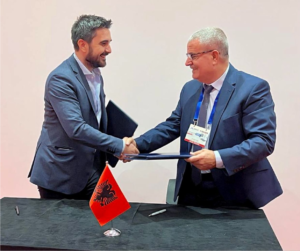
Photo Credit: ERRU & AKUK
Digitalization as a concept represents the appropriate adaptations made to operate a system or process using computers and the internet.
In a water utility, digital transformation involves the implementation of practical tools, software, and hardware that enable increased efficiency in managing technical operations in water supply and wastewater systems, including customer service.
Digitalization in general helps water utilities and their respective shareholders (central government and municipalities) to better understand the aspects of Water Demand, to identify problems and opportunities for reducing losses and optimizing water use, applying principles of water reuse and circular economy, as well as to develop effective water management strategies. These technologies enable real-time monitoring, as well as providing a quick response to water quality issues and emergencies.
In this sense, Digital Transformation in the water sector can play a key role in accelerating progress towards achieving Sustainable Development Goal No. 6 (SDG No. 6) for a safe management of drinking water and sanitation, as well as improving the financial performance of water utilities.
Digital transformation has been and continues to be at the forefront of the International Water Association’s (IWA) attention at its annual congresses on this subject. Urgent need for digital transformation is addressed, presenting advanced experiences such as the Digital TWIN Spatial system, including those for components of the water supply systems, wastewater systems, and water treatment plants, which were the main arguments of the IWA Digital Summit in Bilbao, Spain, in November 2023.
Digital transformation creates conditions for water utilities to collect and report reliable data, enabling regulators and management staff of water utilities to have a real assessment of KPIs (Key Performance Indicators) and setting rational objectives. On the other hand, digitization allows for an efficient monitoring of the sector and each water utility.
The improvement of many KPIs is directly linked to digital transformation in the process of operation and service provision by the water utility, where the main indicators include NRW (Non-Revenue Water), Energy Efficiency, staff/1000 connections, as well as, indirectly they are linked with the O&M Cost Coverage indicator.
The table below shows the KPIs of the sector for the year 2023 with an improvement trend compared to 2022.
| KPI | 2022 Value | 2023 Value |
| Non-revenue water (NRW) (in %) | 63,7 | 64% |
| Staff/1000 connections | 4,73 | 4,6 |
| O&M Cost Coverage (in %) | 90,3 | 104% |
| Energy Efficiency (in Kwh/m³) | 0,65 | 0,5 |
The Albanian Water Regulatory Authority (ERRU) and the National Agency for Water Supply and Sewerage of Albania (AKUK) play an important role in the digital transformation of the sector to improve the efficiency of the services in the respective service areas of water utilities, both economically and in their quality.
ERRU, in the complex process of carrying out KPI analyses, sets objectives for water utilities in the future which are closely linked to the quality or reliability of the data provided by the utility. In this framework, ERRU indirectly encourages digital transformation and modernization of the operation aspects, which enables the utilities to have an accurate and real-time monitoring.
This fact is reflected in ERRU’s decisions on the new approved tariffs for water utilities, accompanied by corresponding recommendations for improving KPIs and in general the management aspects. Improvement of KPIs in many cases is directly or indirectly linked to a digital transformation of operations and services.
Some of the digital transformation tools related to improving water utility management, as well as how they are currently being implemented in the water sector, are provided as follows*
- The SCADA (Supervisory Control and Data Acquisition) System for Operation & Control, which contributes to reducing workforce (staff/1000 connections) at pumping stations, wells, reservoirs, automatic disinfectant dosers, wastewater treatment plants, etc., as well as for efficient monitoring of their data.
In Albania, 13 out of the total of 58 water utilities before their regionalization have SCADA management systems at the main pumping stations, such as Korça, Lushnja, Durres, Librazhd, Lezha, Berat – Kuçova, Permet, Këlcyra, Gjirokastra, Pogradec, Shkodra (partial), and Vlora (out of fservice), representing approximately 20% of the 58 former water utilities.
- Automatic Press Regulators in distribution networks through automatic press reducing valves, especially during the night when the pressures increase due to a drastic decrease of the consumption. The use of these instruments enables the reduction of technical losses by improving the NRW indicator. There are reported that 13 water utilities out of 58 before the regionalization have automatic pressure reducing valves, such as Librazhd, Patos, Korça (in only a few villages), Berat, Shkodra, Durres, Lezha, Pogradec, Gjirokastra, Permet, Kelcyra, Lushnja, Vlora, representing about 20% of the 58 former water utilities.
- Surveillance Camera System for the security of some components of water, wastewater systems, and Treatment Plants, which are considered by law as objects of special importance. Those equipments contribute to reducing the staff/1000 connections indicator. In fact, some water utilities are contracting these services to third parties, which in appearance are not part of their staff, but this service further increases costs, worsening the indicator of O&M Cost Coverage.
Since 2022, ERRU evaluates the staff/1000 connections indicator by placing all water utilities on the same basis, considering subcontracted employees for the guarding service as if they make part of the utility staff. Reporting shows that 10 out of 58 water utilities before regionalization have installed surveillance camera systems in Gramsh, Saranda, Shkodra, Tirana, while in utilities like Vlora, Lushnja, Gjirokastra, Korça, Pogradec, Kamza, but not all components are covered with cameras.
* The data source is from the water utilities according to the relevant questionnaire sent by ERRU
- The online invoice payment system from mobile phones has been installed and is operational for 5 out of 58 individual water utilities or 5 cities, respectively Fier, Korça, Lezha, Tirana, Elbasan, representing approximately 7% of the 58 former water utilities.
- Online consumer complaints, through the 24/7 green number, are only available for some large individual water utilities (Tirana, Durres, Elbasan, Vlora, and Fier), via email (all); the dedicated online platform shuk.al for consumers is available for all water utilities because it is installed at the national central level.
- Automatic Remote Reading of Smart Meters is installed in 5 out of 58 former individual water utilities, such as Korça, Berat (only 5,000 meters), Durres (out of service), Elbasan (out of service), Tirana (only in some private customers).
- Source Meters: It is reported that only 50% of the water produced is estimated by metering. Detailed reporting for each water utility is required for this.
Based on the above data, it appears that generally only the water utilities that have been the subject of investments from foreign donors are entities operating fully or partially with digitalized management tools.
Beyond the above list, other essential elements such as digitalization instruments (or serving as such) also include Variable Speed Pumps, recommended for use when water is pumped directly into the distribution network, rather than from reservoirs. These types of pumps respond in real-time to Water Demand in the distribution network, enabling the improvement of the Energy Efficiency indicator. In this case, they are recommended for the case of the water supply network of the city of Shkodra, which has this characteristic (Rus neighborhood).
It is known that 75% of Water Demand for water utilities is covered by groundwater and springs, while the remaining is covered with surface water (Tirana). Within the framework of climate change issues, alongside increasingly frequent floods, the problem of prolonged droughts is becoming more and more concerning, creating significant problems with water reserves used for drinking water for the population.
In this situation, comprehensive and continuous monitoring of groundwater levels and springs flows becomes necessary. In cases of critical levels of these water sources reserves, the required measures must be part of Risk Management Plans, which should be available to water utilities.
For this purpose, piezometric systems with sensors (in other words, a digitalized system) should be installed in all groundwater to monitor these water reserves levels online, to be carried out by the Water Basin Administration Offices. The observation of their levels dropping below or near the critical levels designated for use should serve as an alarm signal to take appropriate measures to address water demand. The same should be done for spring water sources used by water utilities.
AKUK has one of its priorities to support regional water utilities with the appropriate funds to develop a strategy and practically implement digital transformation, including the most advanced systems of the time, such as digital twin platforms, etc.
ERRU, in collaboration with AKUK, in the framework of reducing staff costs, is proposing necessary changes in legislation regarding the security of Water Supply and Wastewater Systems, such as reservoirs, pumping stations, wells, as objects of special importance. This would enable alternative solutions with lower security costs for these objects, such as replacing the 24/7 guarding service with surveillance cameras and other technical measures guaranteeing their security from possible external interventions.
On the other hand, AKUK will undertake the initiative together with the Water Resources Management Agency (AMBU) in planning dedicated funds for the procurement of relevant digital equipment and instruments for monitoring water sources in respective bassins, which is related to monitoring and ensuring Water Demand in the service area of water utilities.
The current reform in the water sector, which aggregates the water utilities from 58 to 15, also offers advantages in terms liquidity capacity compared to fragmented utilities. Regional water utilities have liquidity opportunities to meet urgent day-to-day needs for purchasing and installing digital monitoring systems, which in some cases are affordable for them.
Another challenge related to the successful implementation of digital transformation is the capacity building of water utility staff to operate these systems professionally, as well as in eliminating/minimizing cyber threats for careful management and protection of data and infrastructure.