


- Street “Pjeter Bogdani”
- N. 13, H. 10, Ap. 15 Tirana, Albania
- Send Mail
- info@shukalb.al
- Make Call
- Tel: (+355/4) 2245 101

Position Paper: Application of Asset Management Products and Capacity Development for Local Governmental Units/Public Utility Companies
1. Introduction
This position paper is prepared in frame of Project “Delivering Capacity Development Products for Water Supply and Sanitation Utilities in Albania” financed by the Project “Regional Capacity Development Network for Water and Sanitation Services” (RCDN). Project overall objective is to improve the capacities of responsible staff in municipalities and water utilities in charge for provision of water supply and sanitation services to citizens, through the delivery of high-quality capacity development products and engagement of both municipal decision makers and management of water utilities. As SHUKALB’s particular focus of work is to provide capacity development and performance improvement products, the specific objective of the project is to expand capacity development offer and delivery for the municipalities and water utilities in Albania, particularly related to the topics of Capital Infrastructure Investment Projects, Integrated Asset Management, and Wastewater Collection and Treatment Infrastructure Projects. Another distinctness of the project is to create an enabling environment through advocacy and lobbying activities in relation to these topics. Through the ongoing work with the project, a Joint Advocacy Strategy has been developed together with the Albanian Association of Municipalities (AAM) and Association for Local Autonomy (ALA), as a result of which a Position Paper is being developed converging to available asset management best practice and its benefits. Management of assets can no longer be purely reactive. This Position Paper is SHUKALB’s takeover attempt to boost Local Governmental Units/Public Utility Companies (LGUs/PUCs) attendance in utilization of Asset Management (AM) existing offer, as well as gain stakeholders’ additional interest and support in AM capacity development to PUCs. This set of work papers is developed to guide Municipalities, donors, and financing institutions on AM by highlighting the most recent developments that are taking place in Albania and in the countries of the region. In this context, SHUKALB, AAM and ALA’s advocating role, as defined in the Advocacy Joint Strategy document will be to foster stakeholders’ attention on need to upgrade technical capacities at PUC level, given the complexities of circumstances in which municipalities and water utilities are faced with. While ‘struggling’ to provide sustainable water supply and sanitation service the utilities should also comply with quality and environmental standards of European Union (EU) Acquis. The Position Paper seeks to address the challenges of water utilities with an aging water and wastewater infrastructure, the decreased or limited funding sources, and need to adopt Information and Communication Technology (ICT) in water sector. Significance of this paper stands in promoting Integrated Asset Management (IAM) best practice, as well as SHUKALB’s offer with regard to LGU/PUCs’ capacity development plans. Main goal is to establish a closer cooperation with ‘players’ such as Governmental agencies, donors, municipalities and water utilities, on asset management gaps and opportunities and help municipalities and water utilities respond to asset management drivers in a more proactive way. It is designated with the intention to
approach Donors and International Financial Institutions (IFI) engaged in water sector with a request for supporting LGUs/PUCs with AM Capacity Development products.
2. Problem History
According to the ERRU’s (the Albanian Water Regulatory Authority) ‘Water Sector Performance Report’ for year 2020, performance indicators show that the situation in the sector appears to have worsened as compared to 2019 with regards to non-revenue water, affordability of direct Operation & Maintenance (O&M) costs for water and wastewater infrastructure, payment collection and water supply coverage indicators. The sewage coverage indicator has remained the same, whereas a slight improvement is noted in other indicators, such as water metering, supply duration, staff efficiency/1000 water supply connections. Drop off performance is explained with the effects of pandemics and the powerful earthquake that hit the country at the end of 2019. Water utilities have historically faced financial difficulties, where in most of the cases it is the Central Government which intervenes to ensure continuity of work. Financial situation of utilities appears to have not improved compared to previous years, even though there was a recovery plan approaching the sector on several aspects. According to ERRU, financial situation in some municipalities was so problematic they could not even cover social and health insurances of respective staff. During the last year, utilities were subsidized with an amount of 720 M All or around 6 M EURs. In the previous years, such funds were used as an incentive to increase performance, while during the last year, subventions were used for mitigation of pandemic effects. For most of the utilities, subvention was used to cover financial gaps created due to situation with COVID 19.According to utilities’ reporting, 21% of subventions went for the pandemics. Another 21% share of subventions went for electricity, which is an old issue that ERRU has always pointed out the need to have it settled through central government, given that the accumulated debt on behalf of Albanian Energy Supply Operator (in Albanian OSHE, today FSU) is 70M EUR and it is just impossible to be repaid by utilities themselves. These conditions testify the extremely unfavourable financial situation of LGUs/PUCs, which are under stress of supporting costs other than salaries. Understandably, required finances for capacity development related measures and application of needed information systems for systematic asset management practices is inexistent. Current situation regarding management of utility assets in LGUs/PUCs of Albania cannot be considered satisfactory. Investments are mostly carried out when the functionality of the system is jeopardized (meaning it cannot provide for the requested or minimum level of service). There is little understanding among the Municipality and Utility staff of what the AM (Asset Management, ISO 55000) is and what kind of benefits it could bring. Planning processes are not very well organized, and they do not provide a clear vision of the future needs and targeted achievements. Even though Business Plans are intended to be a “living” documents for guiding the LGUs/PUCs into the future, as related to management of water and sewage assets, they run out in identifying the technical and financial needs for assets and in providing information of major asset renewal, rehabilitation, or replacement, so that LGU/PUC can plan for these major projects and budget accordingly. Mostly, planning of interventions on the assets is done on an ad-hoc basis. Existing data usually present only inventories and do not provide analysis, therefore it is very unlikely that get used in any kind of decision-making process for the future investments. At the utility level, capacity is low in terms of technical skills and qualified personnel especially in overall management, system operation, maintenance, and assets sustainable management. Lack of qualified staff in some PUCs exacerbates the problem. Scale of PUC reporting in general does not include environmental impact data, energy use efficiency, customer relation and satisfaction, Non-Revenue Water reduction, water metering, pressure zoning, peri-urban population outreach, asset inventory and management system, customer base, and more. Except in some LUGs/PUCs, for major part of PUCs, there is no Asset Management practice set forth.
2.1 Background of the problem
Public utility assets in Albania are managed by the Public Utilities, and the latest (PUCs) are owned by Local Government (Municipality). All aspects of providing water supply and wastewater services are deeply influenced by the municipal authorities. The most common concerns about implementing AM in Albania include:
• Aging of physical assets
• Lack of financial resources for regular maintenance and capital investments, as well as for rehabilitation or replacement of deteriorated assets
• Lack of basic data on characteristics and location of assets.
The institutional framework and division of responsibilities between municipalities and PUCs involves:
Responsibilities of Municipalities:
• Overall planning and development in water and sewage sector (having strategic development plans and spatial plans which define the baseline for management of water resources, with directions and priorities)
• Having respective departments in charge of communal services, as well as communal inspectors, who monitor functioning of communal services at the municipal level.
• Supervising the work of PUCs over the Supervisory Board and the company’s Assembly
• Making decision on water and sewage tariffs upon the proposal made by PUCs
Responsibilities of PUCs:
• Organizing its work and activities in providing water supply and sewage services to all customers
• Covering all costs through the service tariffs, for the public function to be completely fulfilled.
Water utility companies are more than ever under pressure to improve their overall performance and cost efficiency, while facing the need to preserve or modernize their assets without access to funding at the same time. The aging system makes it increasingly difficult for the water utility companies to provide the services desired by the local government units and required by the local citizens and businesses.
An overview of the situation with asset management across its main constituent components involves:
Management.
As operation and maintenance costs increase with the age of fixed assets; the weaker service capacity goes hand in hand with disproportionately high operating costs. Water losses are reportedly one of the main issues that have impact on revenue, increased operational costs, energy waste and wastage of water resources. In most PUCs, maintenance and rehabilitation are insufficient and annual network rehabilitation rates are low. Utility services are normally provided on the basis of respective plans and programs.
Inventories.
Inventories of assets are very basic with limited data of questionable reliability. Categorizing assets according to the type and characteristics and developing assets hierarchy is usually unknown method in most PUCs. Performance and condition monitoring, risk assessment to help prioritize the most critical assets is crucial for PUCs to have a clear knowledge of the condition of their assets and how they are preforming as to assess the need for minor and major repairs, rehabilitation, or replacement. Albania is not implementing any kind of criticality/risk assessment methodology.
Maintenance.
Not enough money is spent on preventive and regular maintenance in order to maintain the functionality and good condition of assets. Almost 50% to 70% of the total revenues are spent on salaries and electricity. Maintenance in many of PUCs is performed when failure already occurs, and the budget spent on maintenance does not exceed 20% -30% of total revenue.
Records of failures.
There is insufficient records regarding the number, type and location of the failures, breaks and blockages, including size and material of the pipe, soil type, installed repair materials.
Information technology.
Adoption of information technologies alone may establish a solid base for further improvements. However, without properly interpreted and accurate asset information full potential cannot be accomplished. With the use of information systems PUCs will be better equipped to analyse the shortcomings and commit to strategic planning in the future. At present, there are 19 PUCs registering their assets in the digital Platform/EDAMS software under Strategic Alliance for Integrated Asset Management (STA-IAM) Project. So far, one of the most noticeable problems constraining the effective deployment of information systems is a lack of information.
Digitalization and Asset Registers.
While there is some progress been made by central government towards digitalization, the process at the local level is lagging behind time. If digitalization at local level does not occur, it will be just impossible to exchange data with the central level – as it is right now – with paperwork. An important prerequisite for introduction of information technologies and digitalization is discovery of data. Collection of information about older assets is difficult and includes field investigation, measurements, examination of archives, cadastral data, construction plans and other more complex means of data retrieval. Information about assets is not properly classified within a trustworthy Asset Register on which a usable information system can be built on.
Human Resources.
All parties involved in the process should have sufficient information and knowledge about AM and its requirements. There are insufficient trainings of employees in the PUCs, especially technical staff. Moreover, frequent changes of PUC staff impact digital transformation process because people to succeed with digital work will need skills that are not easily established. In addition, it needs motivation, which is hard to encourage given the difficult financial situation of the utilities.Municipalities usually have their own strategic/development plans for the water and sanitation sector, which include strategic objectives for the longer period, for example 5-10 or even more years. There is also an obligation of PUCs to make their mid-term and short-term Business Plans regarding more specific operating activities with smaller investments. PUCs in Albania usually make 5-year Business Plans, which contain measures and activities to be done in the following years. In most cases, these business plans could be understood as a “wish list”, since the necessary budget for their implementation is not well and clearly presented. Furthermore, plans for future investments are not the result of evaluation.
2.2 SHUKALB Technical Capacities in Asset Management
Drawing on two decades of experience, some of the core elements of SHUKALB’s approach in implementing successful asset management plans and programs includes helping its members to build strategic foundations, establish service levels and performance baselines, and to develop realistic and integrated capital and financial plans. SHUKALB expertise is built on key professionals who have got long experience with the sector and who have participated in regional activities, networking, and best practice development, including International Standards for Asset Management Systems and ISO 55001. SHUKALB is a resourceful unit that has all the competence needed for assisting PUCs members capture and analyse data about the assets themselves, the condition, location, and real value of their assets, make smarter and cos-effective decisions, to better understand their largest risks and avoid critical failures within their water infrastructure. The utilities are continuously obtained with tailored advice and comprehensive capacity development assistance. SHUKALB has acquired the position of being the Albanian ‘hub’ for IAM best practice and capacity development when it comes to handing it over to LGUs/PUCs. Furthermore, due to participation in various networks and regional initiatives the SHUKALB capacities and resources are further improved through the exchange of experiences with other countries of the region, including Bosnia and Herzegovina, North Macedonia, Montenegro, Serbia, and Kosovo.
2.3 SHUKALB a resource of established expertise and know-how
SHUKALB is currently in the implementation phase of the Project “Integrated Asset Management for Water Utilities in South Easter Europe”, that came as a partnership between Deutsche Gesellschaft für Internationale Zusammenarbeit GmbH (GIZ), Hydro-Comp Enterprises Ltd. Cyprus, and the International Association of Water Supply Companies in the Danube River Catchment Area (IAWD). The program is part of the Danube Learning Partnership (D-Leap), a regional, integrated, and sustainable capacity building initiative of national water utility associations and IAWD. Thanks to these initiatives, a valuable source of products and expertise has been made available to Water Utilities and the entire sector. Aim of the project is to enable Asset Management Centres provide a capacity development services to the Utilities participating in the project to enable them carry out IAM activities through training, support and the provision of appropriate software and best practice methodologies. The Program provides access to an innovative package solution called EDAMS IAM software, which is a state-of-the-art tool for IAM. It is based on best practices. It is a tested and proven methodology that endues utilities to perform a full range of AM solutions. IAM is a tool to accurately identify status of assets of the water supply and sewerage network. By becoming part of this program, PUCs are enabled to better manage the networks and plan for both types of investment capital and asset replacements. Proposed solutions are systematically introduced to the participating utilities through three stages:
Table 1: Proposed solutions for PUCs introducing AM (ref: SEE AM Project)

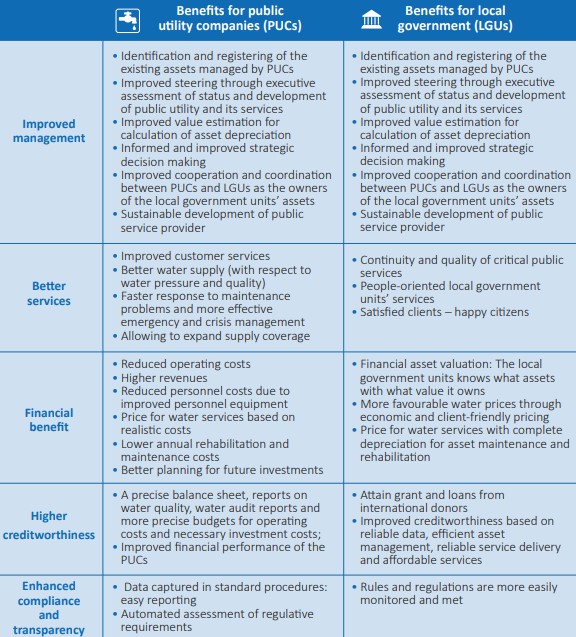
Pinpointed benefits of LGUs/PUCs due to participation in the IAM Program is concisely represented in below table:
Table 2: Benefits due to participation in IAM program (ref: SEE AM Project)
3. Policy Options
Decentralization process is very complex embracing all sectors, including the water sector, which one is also under the impacts that other reformation processes have on it, such as for example the implementation of the new territorial reform, alignment with EU standards and requirements, and e-Governance innovation and digitalization, that are irreversible and evolutionary shaping trends of extremely high velocity. Sustaining water systems requires application of information technologies. The latest has become essential in improving water management and water use efficiency. It integrates capital assets with asset management, water network management, as well as with financial management and planning. Innovative IAM software solutions have already been made available in Albania enabling the utilities to register their assets in a single platform and access technical and financial information whenever necessary.
There is a long history of donor engagement in Albania’s Water Supply and Sanitation (WSS) sector. Currently there are several active donors and International Financial Institutions (IFIs) supporting the development of the water and sanitation sector in Albania. Government and international commitments have been made to extend WSS service in Albania from various supporters such as: KfW, GIZ, World Bank (WB), the European Investment Bank (IEB), the European Bank for Reconstruction and Development (EBRD), and from other bilateral donors – Italy, Japan, Austria, Sweden, Switzerland, United Nations (UN) to upgrade and extend WSS services in Albania. Part of their contribution is focused on institutional development and improvements, although there is room for better coordination and synergy among actors (donors, state agencies, implementing agents, and beneficiaries) in the way these commitments are implemented.
In circumstances when financial situation of PUCs is not satisfactory and their daily management is faced with heavy financial burdens, the asset management process should be considered a long run priority for the water the sector. This would require local administration link with sectorial plans in field of water and sanitation by including in respective business plans, earmarked budgets set for AM purpose.
There are insufficient trainings to the employees in the PUCs, especially related to technical staff. Even though Albanian PUCs staff is familiar with objectives, strategies, plans, service standards, procedures for responding to consumer complaints as well as incidents, it should be noted that they have insufficient information on AM. Evaluation of employees is conducted annually in terms of the realization of the plans and objectives, but the performance of staff should be increased among departments. Special emphasis should be put on asset management.
For obtaining good results on implementation of AM these specific approaches should be considered: improved budgeting; strengthening internal capacity and expertise in terms of human resources, know-how. Drawing on two decades of experience SHUKALB can help PUCs improve asset management practice by developing their capacities to meet the required level of performance, in the most cost-effective manner.
Successful IAM practices will allow utility managers to proactively rehabilitate or replace system components on a continual basis rather than waiting to repair failing or damaged assets when it is considerably more expensive and disruptive to system operations. The choice of the type of intervention should be determined based on the condition and performance of assets, whereas the priority and timing of intervention is determined based on risk assessment.
4. Policy Statements
The current global pandemic and digitalization trends are proving every day that digital transformation and digital solution are not only a nice – to have, but a must – have for water utilities. To build a sustainable water future it is necessary not only to have the adequate infrastructure, but also control in advance what is going to happen and why; what financial implications are going to appear and what planning will require. Benefits of digital transformation involve contingency of plans and transparency with citizens. Various Donors and IFIs past investment, included significant support (more than hundred Million EURs) in capital infrastructure for the water sector, Albania. The statement is going to make three important highlights:
i) Donor programs are the enablers of digital transformation in water, as it is a costly contemporary process that is explored through a rapidly growing field.
ii) Importance of digital platforms needs to further be reflected through donor support. IAM practice will have to be combined with Donors’ capital investments projects, to help utilities advance their service to an upper level. Furthermore, in more concrete and practical terms this would mean for donors engaged in water work in Albania to hand over their investments to end beneficiaries by stating in contractual provisions of respective agreements a clear requirement stating that assets will have to be entered into IAM software by PUC staff.
iii) Donors could play out roles to digitalization to a larger extend than simply twist own investment with IAM. They can provide a larger scale of support for LGUs/PUCs to enable them buy IAM software products and benefit from AM capacity development programs offered by SHUKALB. To conclude with this, management of assets in the long run, calls for support from donors on AM to be included in their plans, along with transition phase that usually follows investment, in order for the water sector to continue consolidating.
Donors can play an important role in promoting the approach that efficient and effective management of water and wastewater systems is essential to ensure long-term sustainability, resilience, and security, that is where Water Sector Asset Management capabilities come in. Donors are in the position to promote the IAM concept to their development partners, provide financial support for capacity development, harmonize their procedures in line with utilities’ needs, and offer their own national experiences where relevant.
In frame of fiscal decentralization, it is the local authorities not the sector ministries that determine allocations to WSS relative to other priorities. Funds from central government are not always ring-fenced for a specific sector when they arrive in local offices. WSS actors and advocates have to work for the inclusion of WSS programs in local work plans, which drive the budgeting process. This implies a focus on IAM products (EDAMS software) and development of capacities at PUC level on IAM best practice. EDAMS IAM software provides a graphical overview of water distribution network and its constituent elements with specific technical elements. It helps PUCs with operation and maintenance management and facilitates the identification of future investment needs. Introducing the AM concepts at all levels (LGUs/PUCs) as well as assigning clear lines of responsibilities for asset management tasks is required. Human resources constitute a part of asset management system that enables implementation of all asset management practices, definition of required knowledge and competence of staff, and understanding a need for training. The premise of successful asset management is that all parties involved in the process have sufficient amount of information and knowledge about asset management and its requirements.
Municipalities and Public Utilities should consider developing together a long-term Strategic plan for utility services, based on detailed analysis of the condition of the existing systems, the level of service it provides and future demands and requirements of all customers. Special emphasizes will have to be put on IAM.
Municipalities and public utilities should be able to understand that appropriate asset management practice expanded at company level helps their soundness and improve financial management, therefore there is need that alliance for IAM practice be downscaled from country level to municipal level.
Capacity development at PUC level is important to open the way to “bottom up” planning on asset management, as that is where implementation of asset management plans has its real test. The absorptive capacity of WSS for financial resources needs to grow: It is often limited due to weak project preparation and poor capacity for implementation. However, SHUKALB can assist PUCs with capacity building in various aspects, including project cycle, financial management, and asset management.
Message of Policy Paper:
Donors’ development assistance and other forms of aid that subsidize most capital investment for the provision and financing of water sector in Albania (as a source of finance and capacity development) should consider to better align their Strategic Financial Plans, (SFPs) with Sector Wide Approach Plans, (SWAPs); and draw on SHUKALB’s domestic experience where relevant in the field of the field of asset management, to enable PUCs apply integrated information technologies which has become essential in improving water management and water use efficiency